






Before the mid 1950’s, almost 100% of cars and light trucks came from the factory with 6-volt electric systems. This was even on larger cars: Packard, Lincoln, Cadillac, Chrysler, etc. Some had 8-cylinder engines with accessory heaters and multi-tube radios. Even the first year 1955 Ford Thunderbird (the pride of their fleet) had a 6-volt with their new 292 V-8 engine!
Starting the engines on these vehicles, even when cold, was not an issue, or the manufacturers would have done something to stay competitive.
THEREFORE, WHAT CHANGES HAVE HAPPENED IN TODAY’S WORLD WHEN YOU CHANGE TO 12 VOLTS?
These are the exact same vehicles that once started with a faster engine turnover. Now, a beautifully restored vehicle is often an embarrassment to the owner who has spent so much time and effort to make it look like it came from the factory. Many throw up their hands and, with the advice of their friends and mechanic, add a 12-volt system. That Was Not Necessary!
Adding a 12-volt battery is the easy part. Installing the total system is NOT. Other, more difficult changes MUST be done:
- The fuel gauge in the dash must have a voltage reducer. It instantly will ruin on 12 volts.
- “All” light bulbs (there are many) must be replaced with readily available 12 volt units.
- Ignition Points. Most all engines with 12 volts before electronic ignition systems operate with 6 volt distributor points. So a protective voltage reducer “must” be added to protect the points.
- The Starter! This is the BIG ISSUE! It is doubtful you will ever find a 12-volt starter that will fit the attaching holes on your 6-volt bell housing. If you do, it still will not work! Sorry, the 12-volt starter drive has a different number of teeth than the 6-volt ring gear around the flywheel was made this way!
Thus, leave the starter as is! It will turn the motor faster for a quick start, but not use it too long or it will ruin from overheating.
YES, THERE IS AN “EASY” NON-EXPENSIVE SOLUTION!
Do not do what most modern-day restorers and auto parts stores tell you or have not even heard of. After all, it has been 70 years since 6-volt systems came on new vehicles. This is before most of today's people were even born!
THE ANSWER:
All 6-volt batteries must have “Double Grounding” to give more current flow to perform like a 12-volt. This grounding is how they came from the factory!
HERE IS THE SOLUTION TO ALLOW YOUR 6 VOLT VEHICLE TO START JUST LIKE WHEN IT WAS NEW!
- You need TWO ground cables (woven, uncovered metal is okay). One from the battery to the frame (the small unused frame hole should still be there) and one from the ear of the starter to the frame (probably is still used as your ground).
- This is Most Important: Please use a double-thick “group #1” insulated cable from the battery to the starter. This is a MUST! It is doubtful you will ever find this at an auto parts store. They are available online in a Google search (know the length you need). Most suppliers only stock the smaller-gauge 12-volt cable. Totally incorrect for 6 volts!
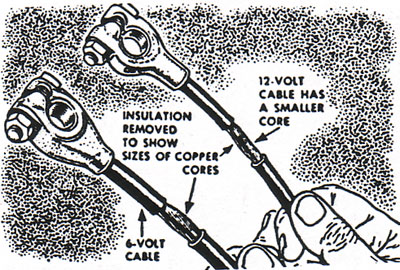
Now, go out with no worry, having a fast-starting 6-volt vehicle by adding these three cables.
We were recently asked to make a presentation at a local early Chevrolet truck meeting. The hope was to elaborate on the above 6/12 volt article. The following is a condensed version of this presentation.
During the early 1950”s, truck and car production had reached all-time highs! Close to one million new vehicles found buyers annually. The big three (GM, Ford, and Chrysler) were in the lead. Other manufacturers were Nash, Studebaker, Packard, Willy’s, and so many more.
IMPORTANT FACT: Almost all of these vehicles used 6-volt systems. It was very successful, OR the companies would have made changes.
Once again, the most common reasons for slow engine turnover using an original 6-volt system is UNDER SIZE battery cables. Most of today’s auto part stores only stock the smaller diameter 12-volt design. Unknowing owners mistakenly replace their original worn cables with shiny new ones that are as much as half the diameter as needed. In addition, the owner probably has no idea he needs “two ground cables”: one from the battery to the frame, and one from a starter mounting bolt to the frame.
SO IMPORTANT: Six-volt starters require twice the electrical flow to operate properly. Don’t blame your six-volt system for slow, unacceptable starter motor speed! Many restorers and even today’s mechanics go to the expense of changing their 6-volt system to 12 volts. They feel their original system was inferior and believe what they did was necessary. This problem can be corrected by just adding the THREE proper cables!
REMEMBER: Millions of cars and trucks (almost all brands of vehicles) were given 6-volt electrical systems each year. If they had not operated correctly, they would have come with 12-volt systems!
During the mid-1950s, a 12-volt system was introduced because so many electrical items were being introduced, such as power windows, electric locks, air conditioning, rear window defroster, and the list goes on. In addition, 12-volt systems use less copper wire in their cables. A plus for the auto factories!