Yes! The Rumor is True! Jim Carter Truck Parts is beginning our 46th Year!
Few if any have reached this milestone.
Jim Carter here, we are just as active in GM trucks as ever!
Click on a year below. See what a near 1/2 century can do for you!
Yes! The Rumor is True! Jim Carter Truck Parts is beginning our 46th Year!
Few if any have reached this milestone.
Jim Carter here, we are just as active in GM trucks as ever!
Click on a year below. See what a near 1/2 century can do for you!
THIS IS US! JIM CARTER TRUCK PARTS AT 45 YEARS
Thank you, thank you, for so many great customers like you that have helped our company reach
our 45th Anniversary. We are so proud to have reached this milestone. This is Jim Carter, I am
still very active as when I started restoring my first pickup, a 1950 Chevy 1/2 ton and needed parts! It now
sits in our Lobby!
Just a Few Extras:
- 17 employees with 130 combined year's expertice.
- Over one million parts in two buildings plus our very own nearby wood shop.
- Partisipated in numerous Swap Meets accross the country over the years.
- House so many more "USED" GM parts than any of our competitors.
- We supply parts to over 20 active nationwide Dealers and 2 in Canada.
- Helped with founding of All American Truck Club of New Zealand.
The pure sealed beam headlight bulb, as most know them, were not introduced until about 1954. Prior to this, a similar design was used on new cars and trucks beginning in 1940. It looked like a modern sealed beam but it was not. Unless you look close, these appear to be the later modern sealed beam. Actually there is a duel filament small bulb inside the assembly. Both nicely interchanged in most vehicles from 1941 and newer. Only 1940 first year is an exception in this design, at least on GM trucks.
The 1940’s headlight eliminated the more complicated light design from 1939 and older. These older units had a silver plated reflector that tarnished, a head light lens, a socket that secured the light bulb, and a non -metal seal to prevent air from entering the silver plated interior. In today’s world we often see this in domestic hand held flashlights that have a removable light bulb.
Almost all of the light bulbs during at least the early 1930’s had double filament headlight bulbs. They were 32cp (candle power) on either the low or high beam setting. This made replacing the burned out bulb a “no brainer”. You just pushed the bulb in the receiving socket and gave it a slight turn. This locked the bulb in place.
Even if you were 180 degrees different each time the bulb was added, it made no difference. Both high and low beam filament in bulb were 32cp.
NOW ENTERS A NEW VARIABLE. An aftermarket company introduces a new bulb with a brighter high beam! It is rated 32cp low and 50cp high. Better roads allowing faster driving needed a brighter high beam.
Because the original bulb receiving sockets remain the same, this new 32cp / 50cp bulb must be placed in the socket just right! The 50cp filament in the bulb MUST be aligned with wires from the main wiring harness. In other words, the high beam 50cp end of a modern light bulb must contact the high beam wire in the harness. (The bulb can only fit one of two ways) If incorrect you will have the 50cp as the low beam. Not good!
1934-36 Duel Filament Bulb
1937-39 Duel Filament Bulb
6 Volt "Almost" Sealed Beam Bulb, 1940-1955







 1934-36 Duel Filament Bulb
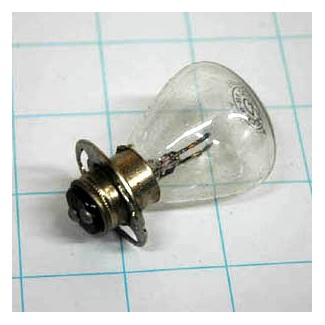 1937-39 Duel Filament Bulb
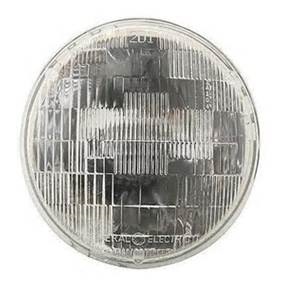 6 Volt "Almost" Sealed Beam Bulb, 1940-1955