Yes! The Rumor is True! Jim Carter Truck Parts is beginning our 46th Year!
Few if any have reached this milestone.
Jim Carter here, we are just as active in GM trucks as ever!
Click on a year below. See what a near 1/2 century can do for you!
Yes! The Rumor is True! Jim Carter Truck Parts is beginning our 46th Year!
Few if any have reached this milestone.
Jim Carter here, we are just as active in GM trucks as ever!
Click on a year below. See what a near 1/2 century can do for you!
THIS IS US! JIM CARTER TRUCK PARTS AT 45 YEARS
Thank you, thank you, for so many great customers like you that have helped our company reach
our 45th Anniversary. We are so proud to have reached this milestone. This is Jim Carter, I am
still very active as when I started restoring my first pickup, a 1950 Chevy 1/2 ton and needed parts! It now
sits in our Lobby!
Just a Few Extras:
- 17 employees with 130 combined year's expertice.
- Over one million parts in two buildings plus our very own nearby wood shop.
- Partisipated in numerous Swap Meets accross the country over the years.
- House so many more "USED" GM parts than any of our competitors.
- We supply parts to over 20 active nationwide Dealers and 2 in Canada.
- Helped with founding of All American Truck Club of New Zealand.
Bet you didn’t know!
The two electric wires extending from the main harness run vertically beside the intake or exhaust manifold to the horn, depending on the year.
Here is the way Chevrolet did it on trucks and cars: From 1938 and older trucks and cars the two horn wires run vertically up to the horn between the exhaust manifold and the intake manifold. When looking at the rear of the intake manifold mounted horn (on the early six cylinder) the two wire attaching posts are on a 4 o’clock position. This results in the two wires being close to the heat of the exhaust manifold. To better protect these wires from heat damage, the factory harness includes a 14 inch corrugated metal loom as part of their complete harness assembly. This metal loom was on all early Chevrolet inline six cylinder vehicles as well as on factory replacement harnesses.
Even with this loom protection, there was still occasional heat damage to the two wires! To solve the problem beginning in 1939, the vertical horn connecting wires changed position. Now, the wire was found on the exterior side of the intake manifold. The two connecting posts were rotated to be at the 8 o’clock position. This made it possible to keep the wires away from the manifold beyond heat. Thus, the protective metal loom was no longer necessary.
Surprise: The mechanical part of the 1934 to 1953 horn can be rotated by the hobbyist. Remove the six securing fasteners, on the perimeter rotate it to the new position, and retighten the securing nuts. Therefore, the horn is easily changed from the early to the later years design. This replacement loom is now available from Jim Carter Truck Parts and other full stocking dealers.
1934-36 horn. Connecting points at the 4 O’clock position
1937-38 horn with wires in metal vertical loom (beside exhaust)
1939 and newer on left. 1934-36 on right (connecting post on opposite sides)
1939 and newer. (Mounted on intake) 8 O’clock position. No metal loom required








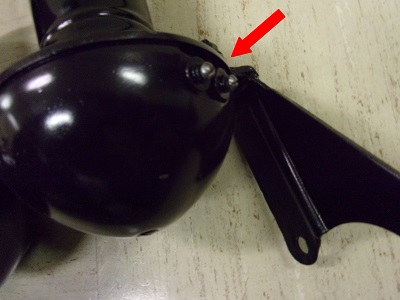 1934-36 horn. Connecting points at the 4 O’clock position
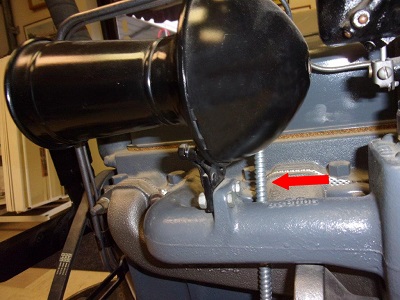 1937-38 horn with wires in metal vertical loom (beside exhaust)
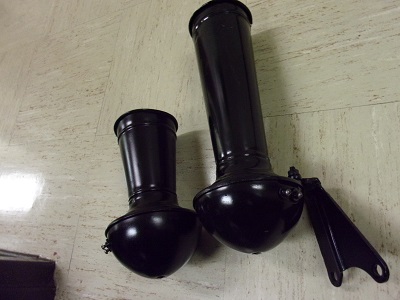 1939 and newer on left. 1934-36 on right (connecting post on opposite sides)
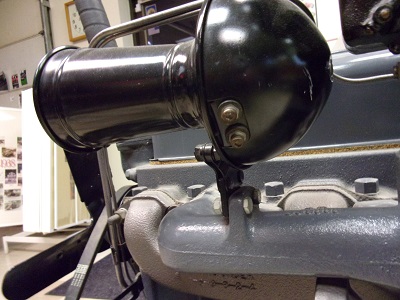 1939 and newer. (Mounted on intake) 8 O’clock position. No metal loom required