






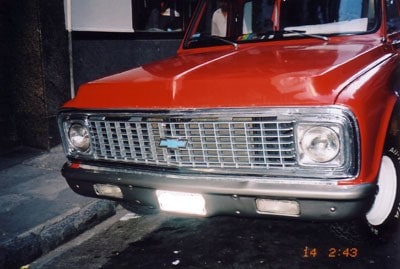
During a recent trip to Buenos Aires, this Argentina built 1971 Chevrolet ½ ton was seen beside a downtown street. Its unique features causes us to take a strong second look. The more we observed this clean little short bed, the more we saw features that were special to this South American Chevy.
The driver was not available so we just took pictures and studied the differences. It appears the GM plant in Argentina used parts from the earlier series of Chevrolet trucks to save much money. This certainly helped make the vehicle more affordable for the local buyer.
Some of the more obvious differences are as follows:
Note the clear park light lenses. (Amber color lenses have been a federal requirement in the U.S. since 1963.)
The wing vent handles were on U.S. trucks in 1960-67 and the total assembly in the U.S. is 1967 only. Why change tooling if the prior design serves the purpose?
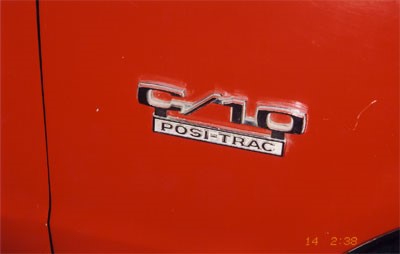
Posi-Traction fender emblem. (Never used on U.S. made Pickups.)
The unique Posi-Traction differential emblem was placed on the right fender, not the left. (Not used in the U.S.)
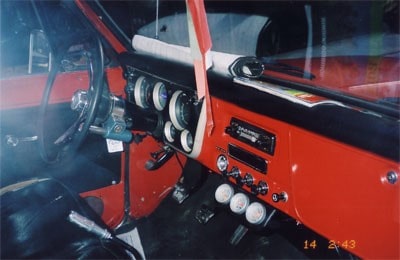
Note: Basic heater lever panel.
Check out the economy heater panel. It consists of a rectangular plate and three pull or turn levers that operate the re-circulator heater. The knobs control temperature, fan speed, and defroster. This system is similar to the basic heaters offered in the mid 1950's in the U.S.
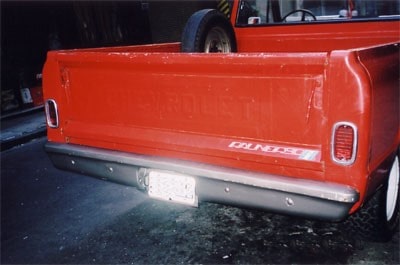
The full back view. (Note: 1960-66 lenses.)
The bed is the most noticeable difference in the Argentina ½ ton. Its tailgate was used in the U.S. in 1958-66, however, it has been modified for the South American trucks. Special latches secure the gate in the closed position. By modifying the bed sides and the older heavier tailgate, limited new tooling was required. Yes, to save costs it even uses tailgate chains!
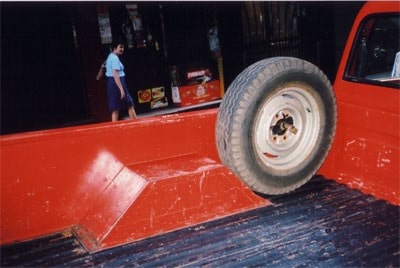
Wheel well tubs made without tooling.
The wheel well tubs are produced with no tooling. Forming, bending, and welding create this finished product.
The metal corrugated bed bottom does not have the same spacing as the US produced pickups. Thus, the floor was produced locally to save production and shipping costs.
A real money saving technique is the use of 6 bolt wheels. See side mounted spare tire in attached photo. In the US, 1971 was the first year for disc brakes with 5 bolt wheels. In Argentina, a big savings was to keep the 1967-1971 non-disc brake system. Therefore, we see the 6 bolt early wheel on this 1971.
In Argentina, the fenders and bedsides are without marker lights. (These were required in the U.S. by 1968.)
Check the tail lights! These are 1960-1966 on U.S. produced Fleetside pickups. This truck does have the red bow-tie molded in the red lens.
Note the resulting sheet metal differences in the rear of the bedsides. There is not any metal contours for the U.S. style, 1967-1972, tail light to fit. There are no back-up lights and using earlier light assemblies’ lowers production costs.
Yes, this feature truck had been repainted in past years but it is doubtful if the tail lights were added to give a custom touch. In Argentina, pickup trucks are used for the purpose they were designed ' as a worker. There, trucks are not Sunday drivers and aren't given appearance changes that would require the owner's disposable income. They are valued in their ability to haul merchandise!
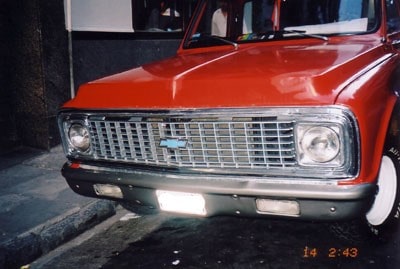
Clear Park light lenses.
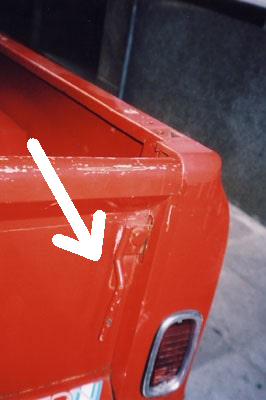
1958-66 latch holds older gate to bed side. Tailgate chains as on earlier GM Pickups.