






Long before today’s high technology, talented people created items with basic available materials to make our lives easier. More famous inventors would be Thomas Edison and Alexander Graham Bell that stands among the more well known. Whether it was one of these two inventors or another, it was discovered two different type metals expand in different ways when heated. If they are attached together, one pulls the other into a curve. Interesting!
Companies that sold an internal combustion engine realized this combination of metals could be used on these engines to allow quicker warm-ups. A great example of this is the bi-metallic coil spring that allowed General Motors and most automotive marques to allow their engines to warm up much quicker during cold weather startups.
What now appears “old school” technology that began over 100 years ago, is that it made a big difference in the operation of the early internal combustion GM gasoline engine.
Here is what made it so practical in the early years of General Motors automotive history. The bi-metallic spring is attached to the end of a horizontal shaft that passes through the top of the cast iron exhaust manifold. Internally, this shaft is attached to a light weight flat metal almost square flat metal plate.
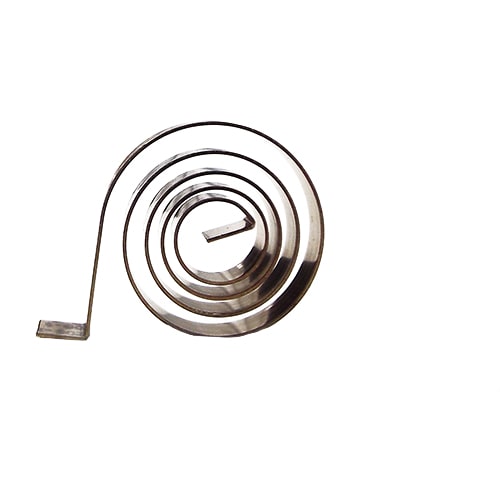

The Bi-Metallic Spring
The Result: When a GM six cylinder cold engine is first started, the exterior bi-metallic spring (see photo) quickly heats, expands, and rotates the shaft and plate moves it to a 90 degree vertical position. This allows the exhaust gas to move directly through the underside of the cast iron intake manifold. What an ingenious method that allows all this to happen automatically!
Note the heavier counter weight on the left side of the exhaust manifold. It is there to help equalize the weight of the flat metal plate, shaft, and rotating friction to allow the small bi-metallic spring to do better as what it was designed for.
There is one problem with this otherwise very excellent system! When the engine is stored for a long period of time (especially in humidity) the shaft can slightly rust to the exhaust manifold. If this is not corrected it will continue to rust in this position. When the engine is started several years later, the exhaust will “always” be directed up through the underside of the intake manifold.
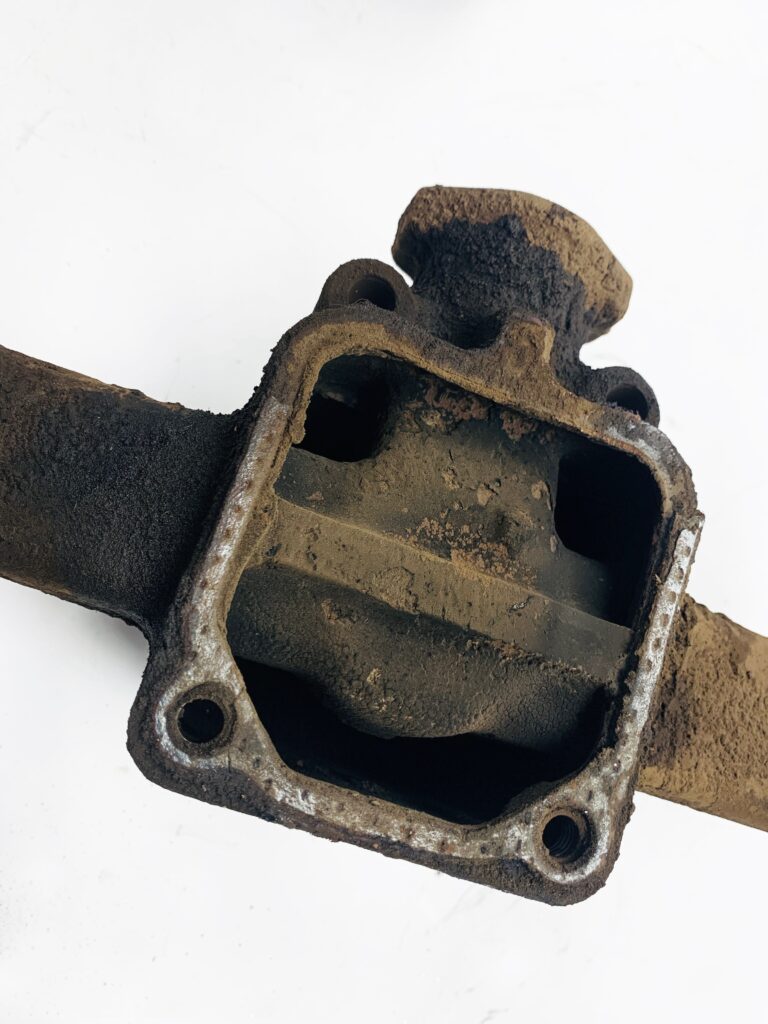
The underside of the intake manifold where it attaches to the top of the exhaust manifold. Note the many ridges in the intake that allow for quicker warming the gasoline on a cold engine. This is from the carburetor that has just combined fuel combustion and air.