





1948 Chevy Truck –“ Heartbeat of America”
Owner: Luke Stefanovsky
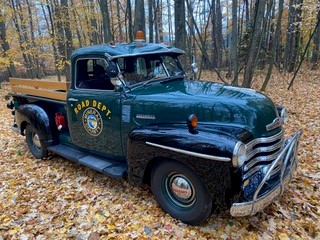
This is my 1948 Chevy 5-window deluxe ½ ton truck that I call "The Heartbeat of America". I was right place at the right time for once in my life spring 2009 when I learned the previous owner in Cadillac, Michigan was letting go of his restoration project. The unfinished truck (and boxes of small parts, along with a truck bed and trailer full of larger parts) was hauled to my pole building in West Branch, Michigan for the fun to begin.
This project became a great stress-reliever from the daily responsibilities of being a middle school principal in Mt. Pleasant, Michigan. I retired 2012 from my life's work as a public school educator, spending the last 21 years as a principal. My waking hours were spent thinking about the truck; it occupied my dreams as well! I approached the restoration as if it were a life-size plastic model kit, similar to those I patiently glued together and painted as a youth.
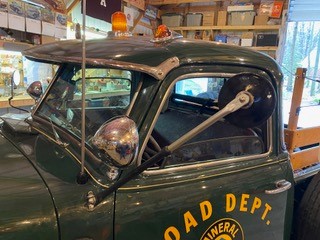
This old truck was in the service fleet for the Road Department in Mineral County, Nevada (county seat is in Hawthorne) until the mid/late 1960s. This area is high desert between Reno and Las Vegas, and home to the world's largest ammunition storage depot. It played a pivotal role in supplying ordnance to the Pacific Theater during WWII. The Mineral County decals on the side of the doors were compliments of a recent supervisor for the road department. I have talked a few times with the local Nevada man who purchased the truck from the Mineral County Road Department; it has had multiple owners since then. Included in the ownership is a couple that lived in Texas, who then moved with the truck to the northern lower peninsula of Michigan.
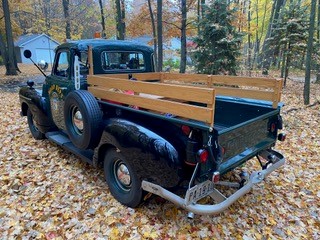
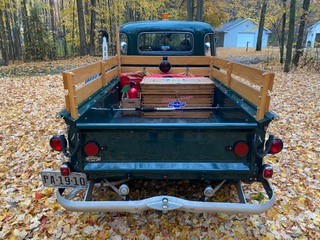
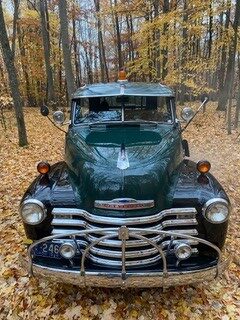
Patched holes from a roof-mounted service light were clearly visible when the headliner was replaced. A period-correct amber Federal service light was purchased and mounted it in its original location, operated by a vintage switch under the dash. K-D 517 amber cab clearance marker lights were also mounted on the cab roof. Five vintage red reflex Guide/Stimsonite reflectors and two amber King Bee reflectors clearly mark the truck box/tailgate and help identify the vehicle as a service truck. The GM accessory road reflectors and Bolser smudge pots mounted on the bedsides help with that as well. A rare 1948 Nevada highway department exempt license plate is mounted on the front of the truck. A 1948 Michigan license plate is mounted on the rear.
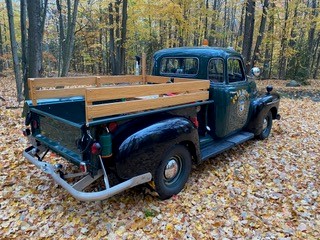
Further evidence of the truck's past includes an original set of cargo tie-down hooks that can be seen below the tailgate area. These hooks were used to hold a tarp in place over the truck bed. Additional vintage WWII era cargo tie down hooks were located and fastened in the original mounting holes on the side rails. A heavy-duty tan canvas tarp is once again secured in place. Holes in various other locations around the truck where various items were mounted could be seen when I bought the truck. Three holes below the left headlight still are puzzling--any ideas? IF THESE OLD TRUCKS COULD ONLY TALK! I BELIEVE THAT THEY DO SPEAK TO US, BUT THEY STILL CAN NOT COMPLETELY TELL THEIR STORY.
Some accessory items have been obtained and re-installed in some of these holes. A hole in the dashboard is where the wiring for the vintage N.O.S. illuminated Hull compass passes through. A vintage one-quart brass Pyrene fire extinguisher (non-working) is mounted on the passenger-side kick panel near the Harrison heater. The mounting holes for the bracket fit exactly where the pre-existing holes were located in the sheet metal. The same is true for a N.O.S. Casco rubber-bladed fan on the upper-left of the dash.
The man that I bought the truck from began a "frame-off" restoration in the late 1980s. He did most of the undercarriage and bodywork. Nearly all the sheet metal is original. When I learned of the truck's original background history, I was determined to present it as it may have appeared back in its day. This truck remains a virtual time machine. The most modern features of the truck today are bias-ply looking radial tires, a dual master brake cylinder, and roller tapered front wheel bearings. I feel that I am a better driver when behind the wheel of this truck, even though it is probably one of the least safe vehicles on the road. The lack of modern technology makes me more attentive when I drive. Less distractions cause me to feel as one with the truck.
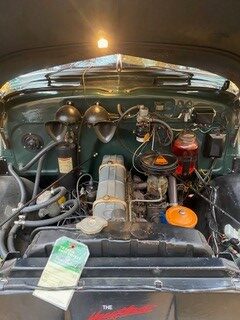
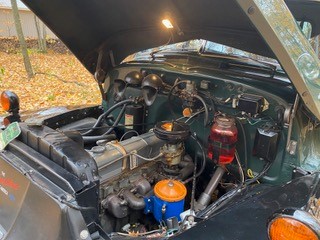
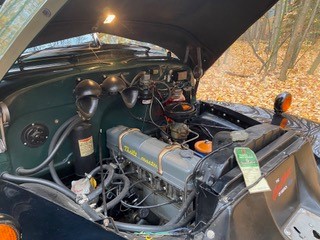
The truck began turning heads when I was able to get it back on the road again August 2009. It now has nearly 11,000 miles on a completely rebuilt 235 c.i. 6-cylinder engine pulled from a 1955 Chevy truck. It runs just like an old sewing machine. I swapped out the 235 valve cover with a 216 valve cover, and am using some unique vintage after-market brass hold-down brackets. (Very rare) See the Technical Article written on the Jim Carter Truck Parts website. The 6-volt truck has its original 4-speed stick (floor) shift with a 4.11 rear-axle. It runs really sweet 55 - 60 M.P.H. during my annual driving season of April - October. The fall 2022 standard tune-up included replacing the clutch. A rebuilt single barrel Rochester B carburetor helps me get about 15 m.p.g. using Rec 90 ethanol free gasoline. The engine bay sports several accessories that spark interesting conversations with lookers. They include dual horns, N.O.S. windshield washer, Trico Electro-Vac wiper booster motor, an overflow radiator tank, A.C. bypass oil filter, and an N.O.S. Perry Cooling System filter system.
Several original and N.O.S. parts were used throughout the truck during my restoration. Many have help return the interior to its original look. They include both armrests and inner door trim panels, sun visor pads, glove box light, cigarette lighter, restored Harrison fresh air heater, and a restored AM radio. All trim pieces were located, painted and installed, including a pair of rear headliner support bars (found only in the early Advance-Design trucks), which are evidenced by the four small buttons in the headliner. A Guide 6004 turn signal was rewired and placed into service. The steering wheel was restored, and it was repainted its original color, along with the steering column. I repainted the cab interior the same color as it left the Oakland, California factory in April 1948. The stripes were repainted on the radio speaker grille, glovebox door and ash tray. Lastly, I had the bench seat and back redone in 2012 with after-market materials similar to what it came with down the assembly line. In February 2025 I acquired N.O.S. maroon upholstery fabric; I plan to install it spring 2025. A small square 4-speed shift pattern plate fixed to the dash between the instrument gauges is a proven conversation starter.
There is more. With safety in mind, seatbelts had to be added--the only way my wife and son Derek were going to ride with me! Furthermore, the running boards were Rhino-lined, and reproduction step plates were added for more sure footing. A unique feature, strictly for safety reasons, is the addition of a 3rd stoplight to the front bed rack/rail. I have added Guide D-68 lamps front and rear, Guide B-31 back-up lights (switched with a rare Delco Remy BACK switch), and N.O.S. Guide clear fog lights. An original set of Guide black-metal back sealed-beam headlights are also in use. The rear driver's side Guide tail light housing/bracket is original. N.O.S. Stopray/Guide taillight lenses are in use. A reproduction rear passenger taillight was added. The original 6-volt electrical service has been completely rewired. All of the gauges in the gauge cluster work as they should, including a reliable N.O.S. fuel gauge. The rebuilt speedometer/odometer is very accurate as well. My 6-volt battery of choice is the red-top Optima.
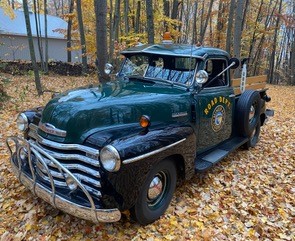
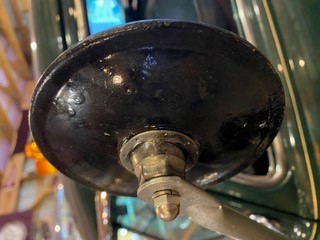
The side-mounted spare tire (with a restored Hurd lock), decorative used hood ornament, and an N.O.S. under hood lamp (a now very difficult-to-find accessory) were added. The bed was refinished. New wheels were painted/striped and mated to a new set of tires, along with new hubcaps. The cab was hand-striped as well. An original GM front bumper is in use. A rare original 5" round mirror head is used with an extension arm on the driver's side. See the Technical Article written on the Jim Carter Truck Parts website. After racking up 10,000 miles on the road with this old gal, I replaced the front wheel bearings with modern tapered bearings spring 2024.
There are six interesting finishing touches on the exterior that I have been fortunate to include in the restoration. They include a side-mounted spare tire and a vintage Smash Hit grille guard that I had rechromed. I also restored the Smash Hit heavy-duty rear bumper. The very rare 1953 GM truck outside sun visor (made by Dieterich) needed a full reconditioning as well. I ran into a N.O.S. Guide S-16 spotlight and installed it April 2019 on the driver's side. I restored a nice used Guide S-16 spotlight and installed it on the passenger side April 2024. Lastly, I located a Detroit Products Co. #123 mechanical signal arm and fully restored it and mounted it April 2021. These are all quite the conversation pieces on a regular basis.
Seeing smiling faces on both young and old has made this restoration satisfying. Along the way, countless new friends have been made, some over the phone, others via the Internet and e-mail, and many in person. The information, help received, and locating miscellaneous original and N.O.S. parts from the Stovebolt.com forum have been most helpful and appreciated. The H.A.M.B., the V.C.C.A., Facebook groups and eBay have been good places to find parts. If I have learned one thing through this restoration process, “a person is never done with the restoration!”
Younger brothers Joe and John were a big help on the project. Joe assisted on the electrical side of the project, as well as the body finish. John topped off the restoration by building a set of bed racks/rails out of red oak left behind by our deceased Grandpa K (the "Judge"--who ironically retired from the road department in Bay County, Michigan.
On a side note, my deceased father Fred was a big supporter of this truck restoration project. In 1966 he used an early 1950s Chevy 3-window pickup truck with vented windows to haul building supplies to build a house for his growing family in Zilwaukee, Michigan (outside of Saginaw). When finished building the house, he sold the truck for the same purchase price.
The truck has been receiving attention after I got it back on the road. A newspaper article was also written on the truck in the Mineral County Independent-News June 2011. The truck has participated in Back-to-the-Bricks events, which has included trips to the showroom of the local Chevrolet dealer. The truck and I have also appeared on local TV through those events. It was highlighted in a TV advertisement by WJRT TV-12 of Flint, Michigan for the June 2017 Back to the Bricks Promotional Tour. The truck has taken part in Old US-27 Tours many summers as well. This classic American truck has appeared in multiple calendars and magazines. The truck has also appeared on multiple websites. In 2021 a watercolor painting of the truck was done in East Tawas, Michigan by a local artist. That painting is now displayed in my home.
Attending the Vintage Chevrolet Club of America's 50th Anniversary meet in Flint July 2011 sure was quite a fun event! My truck received Chevrolet Driver Participation Class (CDPC) certification after attending the VCCA's 60th annual Central Meet at the Gilmore Car Museum (near Kalamazoo) July 2023. The award is intended for vehicles that are described as "Drivers" and are not show cars. Vehicles are certified if they are visually representative of the VCCAs mission statement of restoration and preservation. All 4 major components (exterior body, interior, chassis, and engine) must be visually representative for the year of manufacture from 5 feet away. I initially had to participate in a Field Entrance Check to demonstrate that the vehicle safety features were in proper working order. I was then allowed on the show field to move through the certification process with a team of judges. This honor validates the restoration I started in 2009. When I am done playing with the truck, the oval becomes a bargaining chip to find the next caretaker. Car enthusiasts are in for a day-long treat touring North America's largest car museum if they decide to visit; you will not be disappointed! NOTE: All I ever wanted was an old truck to wrench on; the attention that the truck has received was never in my thought process. My next project? I would like to locate a solid WWII era "Art Deco" Chevy or GMC truck and restore it back to its former glory.
The “Heartbeat of America” has come back to full life and lives well again, 77 years after it rolled off the assembly line. Now in my mid-60s, I see this restored 1948 Chevy truck as a tribute to the rich auto heritage of the great state of Michigan.
If you wish to contact Luke, please send him an email at: lukejstefanovsky@gmail.com